La Sagra de Toledo
Lazarillo de TormesLa Sagra de Toledo is the setting for the indulgence seller’s most elaborate staged deception in Lazarillo de Tormes. There, a failed attempt to sell indulgences gives way to a carefully performed quarrel, apparent divine punishment, and public reconciliation; the resulting belief spreads beyond the village and transforms the seller’s fortunes.
Setting and the Failed Sale
The episode takes place in a village in La Sagra de Toledo, where the seller has preached for two or three days without persuading anyone to buy an indulgence. His usual persuasive devices have failed, and the villagers show little inclination to purchase. Their indifference sets the practical stakes: the seller needs to convert a doubtful audience, and he decides that ordinary preaching will not do it.
He announces that the indulgence will be withdrawn the following morning, summoning the village for the occasion. The announcement creates a public event around an object that had attracted no buyers. The district thus becomes not merely a stop on the seller’s route but the testing ground for a scheme built to make skepticism itself part of the performance.
The Staged Dispute
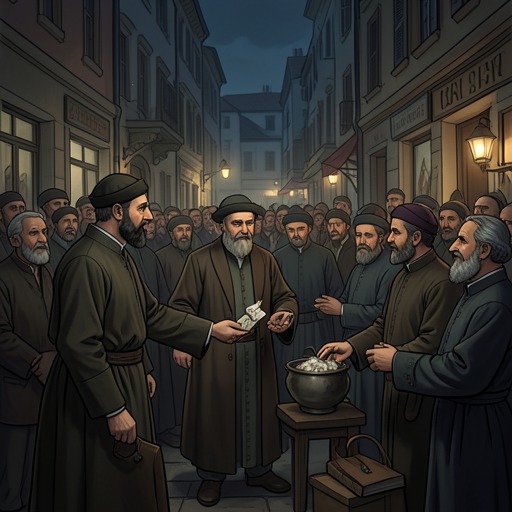
After supper, the seller and the constable begin a drinking game. They move from play to insults, accusing one another of being a thief and a fraud. The seller takes up a large pike; the constable reaches for his sword. Their raised voices bring guests and villagers running, and the crowd becomes so dense that the two cannot get at one another with their weapons. The constable nevertheless makes the accusation that will shape the next morning’s gathering: the indulgences are false.
The following day, the seller has the church bells rung for Mass and the sermon announcing the withdrawal of the indulgence. Rumors from the previous night have already turned the village against the sale: people say the indulgences are false because the constable himself had said so. The seller begins his sermon from the pulpit, urging the congregation not to forgo the benefit the indulgence promises. In the middle of it, the constable enters, prays, and publicly claims that he had agreed to help the seller divide the profits but now repents because the scheme would harm both his conscience and the villagers’ purses. He declares the indulgences false and says he has no further part in the fraud.
The Counterfeit Miracle
The seller allows the constable to speak, forbidding the congregation to silence him. Then, kneeling on the pulpit, he appeals to God as the witness who can reveal the truth. He proposes a test: if the constable’s accusation is true, the pulpit should sink beneath the earth with them; if the seller is telling the truth, the constable should be punished and his malice exposed. The terms turn the dispute into a supposedly observable trial of divine authority.
As soon as the seller finishes, the constable falls to the floor. He groans, foams at the mouth, twists his face, kicks, and strikes the ground. The assembled villagers are frightened and cry out for help. The seller then frames the apparent seizure as an occasion for mercy rather than revenge. He leads the people in prayer, approaches with a cross and holy water, and conducts a long, fervent oration that moves the congregation to tears. Finally he places an indulgence on the constable’s head; the man gradually recovers, asks the seller’s forgiveness, and confesses that the devil had prompted his accusation, both to avenge the quarrel and to obstruct the good the indulgence would bring.
Aftermath and Narrative Significance
The seller forgives the constable, and the two reconcile. The villagers rush to obtain indulgences, so that almost no one in the village remains without one. The story then travels to neighboring places: in ten or twelve villages the seller moves thousands of indulgences without needing to preach, as people come to buy them at the inn.
Lázaro initially believes the spectacle. Only when he later sees the seller and the constable laughing heartily over what happened does he understand that the miracle was planned. His belated recognition makes the episode’s audience part of its subject: the villagers’ fear and devotion, and Lázaro’s own credulity, help certify the fraud. La Sagra de Toledo therefore marks a sharp reversal—from a place where no one will buy to the starting point of a rumor-driven success—and exposes how staged conflict, ritual gestures, collective response, and retelling can make deception appear to confirm religious authority.